
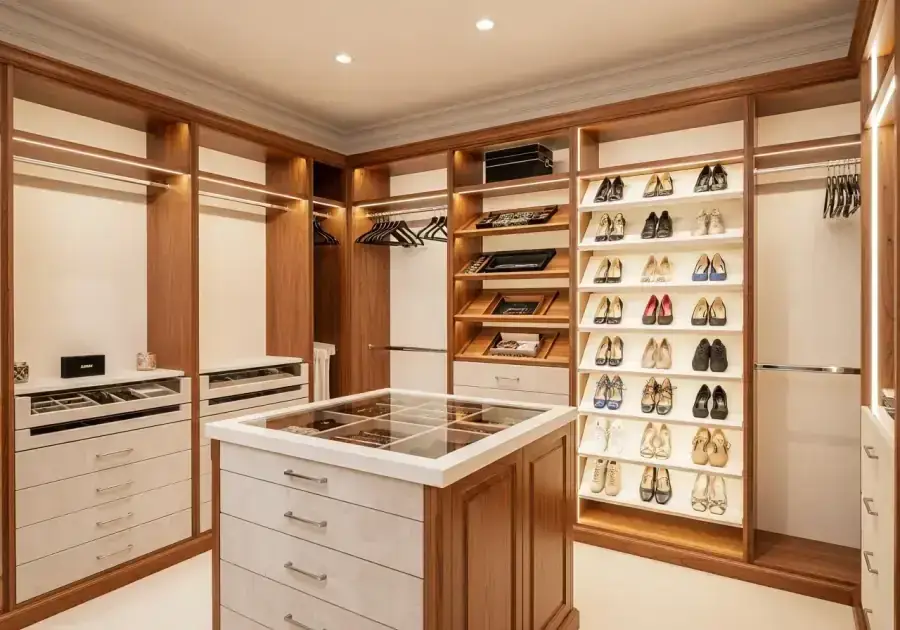
After 37 years and thousands of closet projects in Bettendorf, Davenport, Moline, Rock Island, and the surrounding communities, patterns emerge. The closets that stay organized share certain characteristics. The ones that become chaotic again within months share others.
Here are the ten principles we return to again and again.
1. Design for your actual wardrobe, not a wish version of it.
The most common mistake in closet design is designing for the wardrobe you intend to have rather than the one you currently have. If you own 60 hanging garments, design for 70. Do not design for 40 because you intend to donate. Donation is real; the closet needs to work now.
2. Double-hang before anything else.
If your closet currently has a single rod and you are looking for the highest-impact change, add a double-hang section. Two rows of short garments in the same width as one row is the most efficient use of closet real estate available.
3. Get shoes off the floor.
Shoes on the floor are the source of most closet chaos. They block access, create visual disorder, and get damaged. Angled shoe shelves cost relatively little and eliminate the single most disruptive closet habit most people have.
4. Build in drawer storage.
Without drawer storage in your closet, folded clothing either goes on open shelves (where it topples) or into a bedroom dresser (which takes floor space the room needs). A full drawer tower built into the closet handles both problems.
5. Light every section.
A single overhead light creates shadows in every corner. Under-shelf LED strips illuminate every rod and every shelf. This single change — lighting — has the highest satisfaction rate of any closet upgrade we install.
6. Designated laundry hampers prevent floor piles.
A built-in laundry hamper inside the closet gives dirty clothing a specific home the moment it comes off. Without it, the floor is the default. With it, the floor stays clear.
7. Use upper shelves for seasonal items only.
Upper shelves — above comfortable reaching height — should hold items you access a few times a year. Seasonal clothing, holiday items, rarely used accessories. Prime real estate is from shoulder height down; protect it for daily use.
8. Categories beat alphabetical or color organization for daily life.
Organizing by type (all shirts together, all pants together, all jackets together) makes your closet faster to use than organizing by color or any other system that requires scanning across categories. Group by what you reach for at the same moment in your morning routine.
9. Leave slack.
A closet packed to 100% capacity becomes disorganized with the first new purchase. Design with approximately 15–20% slack — space for things to grow. You will always acquire more. The closet should accommodate it.
10. Maintain it twice a year, not daily.
A well-designed closet does not require daily tidying — items go back to their specific places naturally. But twice a year (typically at seasonal rotation), do a full review: what no longer fits, what is never worn, what needs to be relocated. This prevents the decade-long accumulation that makes a good closet slowly become a chaotic one.
To put these principles into a real system for your Quad Cities home, call (563) 355-8295 or visit our Bettendorf showroom at 1741 State Street.